
Enslavement in Bermuda
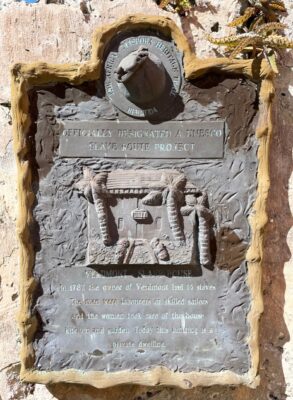
African Diaspora Heritage Trail Inscription at Verdmont
Since 2021, the Bermuda National Trust (BNT) has participated in Re-imagining International Sites of Enslavement (RISE), an international knowledge-sharing programme bringing together people who care for and interpret heritage sites across the Atlantic connected to the transatlantic slave trade and enslavement.
RISE is a collaboration between the International National Trusts Organisation (INTO) and the US National Trust for Historic Preservation. Through the programme, heritage practitioners share knowledge, experiences and approaches to researching, conserving and interpreting sites associated with enslavement and its legacies.
Reinterpreting BNT’s heritage
BNT’s participation in RISE is helping us to deepen and strengthen the interpretation of the many places and collections in our care connected to the enslavement of people of African descent, as well as related histories of Black resistance, resilience and empowerment.
We recognise that this work requires us not only to expand the stories we tell, but also to consider whose voices and perspectives shape those stories and how they are shared. Working collaboratively with researchers, community members and other partners is therefore an important part of our approach.
Our local RISE Advisors
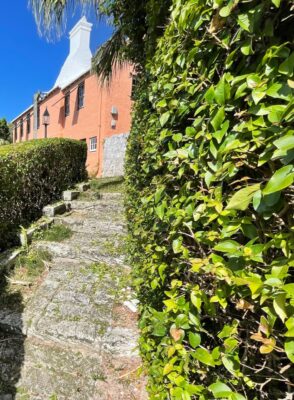
Steps to possible quarters of enslaved people at Verdmont
To help ground this work in Bermuda, BNT has developed a cohort of local RISE Advisors, bringing together community leaders, educators, curators, heritage practitioners and other community members with knowledge and perspectives relevant to this work. Members include representatives from the African Diaspora Heritage Trail Foundation (ADHT), Citizens Uprooting Racism in Bermuda (CURB) and the Ministry of Education (MoED).
The RISE Advisors contribute local knowledge and perspectives to BNT’s initiatives and provide an important forum for exchanging ideas about how sites and histories of enslavement are researched, interpreted and shared. Their involvement helps connect the international exchange fostered through RISE with Bermuda’s own communities, histories and heritage practice.
Through RISE and our local partnerships, BNT continues to learn from international heritage practice while developing approaches rooted in Bermuda’s own history and communities. This work is informing the evolving interpretation of our museums, historic sites, cultural landscapes and collections, while helping us research and share stories that have previously been overlooked or underrepresented.
Get involved
This is ongoing work, and we welcome community participation. To learn more about BNT’s involvement in RISE, contribute knowledge or perspectives, or find out about our evolving interpretation of heritage associated with enslavement and its legacies, please contact Head of Cultural Heritage Dr Charlotte Andrews.
Below are links to searchable spreadsheets transcribing the Bermuda Slave Registers for 1821, 1827, 1830, and 1833-4. The original hand-written ledgers are held by the Bermuda Archives, which ‘collects, protects, and makes available, records of the Bermuda Government and private collections which have enduring historical and cultural value’.
Following the Slave Trade Act 1807, Slave Registers for British Colonial Dependencies were kept between 1813 and 1834, primarily to distinguish enslaved people who had been so-called ‘lawfully enslaved’ from those who were illegally trafficked from Africa to the British colonies. The Registers were usually revised every three years up until the Slavery Abolition Act 1833 led to the Emancipation of all enslaved people in the British Empire—including Bermuda—from 1 August 1834.
Dr. Virginia Bernhard of the University of St. Thomas in Houston transcribed much of Bermuda’s Slave Registers for 1821 and 1834. They have been made publicly accessible with her support, and the support of the Bermuda Archives team and the first Bermuda Ombudsman. The Bermuda Archives has also developed working spreadsheets for the 1827 and 1830 Bermuda Slave Registers.
The spreadsheets include the number, names, sex, and occupation of enslaved people alongside the names and sex of enslavers. The ages and birth places of enslaved people may be searched in microfilm of the originals at the Bermuda Archives.
Bermuda National Trust is pleased to provide public access to the following spreadsheets of the Bermuda Slave Registers, with permission of the Bermuda Archives in the Ministry of Education, Government of Bermuda.
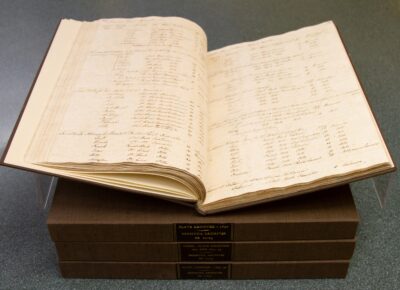
Bermuda Slave Registers. Photo Credit: Bermuda Archives
Please note:
Bermuda Archives staff and affiliated researchers continue to revise these working transcriptions, including filling gaps and correcting transcription errors.
The spreadsheets reflect the original language transcribed from the original historical documents, except for the column headers which have been edited.
Bermuda Slave Register 1821 (Bermuda Archives Reference: RS 01/01)
Bermuda Slave Register 1827 (Bermuda Archives Reference: RS 01/02)
Bermuda Slave Register 1830 (Bermuda Archives Reference: RS 01/03)
Bermuda Slave Register 1833-34 (Bermuda Archives Reference: RS 01/01)
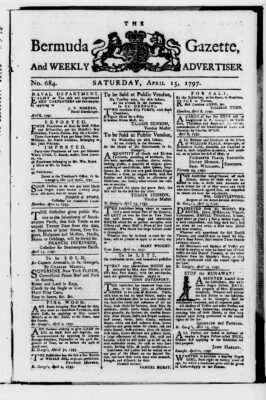
Royal Gazette & Weekly Gazeteer published 15 April 1797
While doing research for her book, Dance Bermuda, Conchita Ming took note of advertisements in the newspaper about the escape or sale of enslaved people in Bermuda. As she read the ‘heartwrenching’ ads, she felt compelled to write them down, until she eventually compiled all such ads published in the Bermuda Gazette (later Royal Gazette) from 1784 until Emancipation in 1834. Conchita says, “I found myself cheering for those who ran away, especially if they were ‘at large’ for long periods. The newspaper did not report if ‘runaways’ were caught so it is not known what happened to them. They are heroes, nonetheless, yearning for freedom. I wanted to ‘Say Their Names’, to acknowledge them and even recognise their skills which helped to ‘build’ Bermuda.”
Conchita Ming has generously shared her compilation of enslaved advertisements with the Bermuda Archives where she conducted her research and they have permitted the Trust to share the compilation here.
Say my Name, Runaway & Sale of Slaves, Bermuda 1700s to Emancipation
Spittal Pond Nature Reserve is an important natural and cultural landscape. Two sites within the reserve—Portuguese Rock and Jeffrey’s Cave—connect this Bermuda landscape to wider histories of the Atlantic Slave Trade, enslavement and resistance.
BNT has reinterpreted both sites as part of our ongoing work to research and more fully represent these histories.
Portuguese Rock
Portuguese Rock preserves an inscription believed to have been carved by survivors of a Portuguese shipwreck in 1543, decades before permanent English settlement of Bermuda.
Earlier interpretation focused on the shipwreck, inscription and the longstanding presence and contributions of Bermuda’s Portuguese community. Further BNT research placed the vessel within the wider sixteenth-century Atlantic world. When its thirty-man crew was shipwrecked on Bermuda’s reefs, the vessel had already sold its cargo, which very likely included enslaved Africans, and was returning to Portugal.
As part of the reinterpretation, BNT invited Bermudians of African and/or Portuguese descent to a focus group at Verdmont, facilitated by Citizens Uprooting Racism in Bermuda (CURB) Executive Director Stacey-Lee Williams. The discussion explored how the site’s interconnected histories of the Atlantic Slave Trade and Bermuda’s Portuguese heritage could be more fully represented.
The revised interpretation now acknowledges the site’s connection to the developing Atlantic Slave Trade while continuing to celebrate the longstanding presence and contributions of Bermuda’s Portuguese community.
Jeffrey’s Cave
Jeffrey’s Cave is named for a young man who attempted to escape his enslavement by hiding in a small coastal cavern. Jeffrey remained hidden for several weeks despite his enslaver’s extensive search and advertised rewards for his recapture. He was eventually discovered after his enslaver followed an enslaved young woman who had been secretly bringing him supplies. What punishment Jeffrey and the woman who helped him endured is unknown.
Their story commemorates the resistance and resilience of enslaved people in Bermuda and the risks taken both to seek freedom and to help others do so. Jeffrey’s story also resonates with Bermudian researcher Conchita Ming’s Say Their Names project, which records the names and stories of enslaved people advertised for escape or sale in Bermuda’s historic newspapers, helping to restore individual identities to people too often recorded simply as property.
In 2021, community concerns about the language used on the existing sign prompted BNT to reconsider how the story was told, making Jeffrey’s Cave the first BNT site to be reinterpreted as part of this wider work. The revised interpretation focuses more clearly on Jeffrey as a person seeking freedom, recognises the woman who risked helping him, and uses language that describes enslavement as something inflicted upon people rather than an identity that defined them.
We do not currently know where Jeffrey was enslaved. Verdmont, another BNT property and African Diaspora Heritage Trail site where people were enslaved, is nearby. Could Jeffrey have escaped from Verdmont or another property in the surrounding area? There is currently no evidence establishing such a connection, but it remains an interesting question for further research.
Jeffrey’s Cave is part of the African Diaspora Heritage Trail Bermuda and an officially designated site under the UNESCO Routes of Enslaved Peoples Project.
Learn more about Enslavement in Bermuda and BNT’s ongoing reinterpretation work.
Planning a visit? See Spittal Pond Nature Reserve for visitor information.
Black history is Bermuda’s history
At the Bermuda National Trust, we believe that researching, preserving and sharing Black Bermudian history must be a year-round priority, embedded throughout our museums, historic sites, collections, research, education and wider cultural heritage work.
The experiences, knowledge, labour, resistance, creativity and achievements of people of African descent have too often been marginalised or excluded from traditional heritage narratives. BNT is working with community partners to address these omissions and to more fully represent the people and histories connected to the places and collections in our care.
At the same time, Black History Month provides an important annual opportunity for focused reflection, learning, collaboration and public engagement. Each February, we seek opportunities to highlight Black Bermudian heritage, connect Bermuda’s history with the wider African Diaspora, and work with others to explore how these histories are researched, remembered and shared.
Collaboration and community engagement
Partnership is central to this work. BNT has collaborated with organisations including the African Diaspora Heritage Trail Bermuda Foundation (ADHT), Citizens Uprooting Racism in Bermuda (CURB), Corporation of Hamilton, Department of Culture, Long Story Short, Titan Express/Sankofa, US Consulate General in Bermuda and others on research, interpretation, exhibitions, talks, tours and community engagement related to Black Bermudian heritage.
Our partnership with ADHT Bermuda is especially important, as four sites on the African Diaspora Heritage Trail are entrusted to BNT’s care: Verdmont and Jeffrey’s Cave in Smith’s Parish, and Tucker House and Samaritan’s Lodge in St George’s. Working together helps us strengthen the research, preservation, interpretation and promotion of these sites and the wider histories of Bermuda’s African Diaspora.
Our participation in Re-imagining International Sites of Enslavement (RISE) also supports this work. Through RISE, BNT exchanges knowledge with international heritage practitioners while working with local RISE Advisors, community leaders, educators, curators and other community members to bring Bermudian knowledge and perspectives into the reinterpretation of sites and collections in our care.
Talks, learning and dialogue
BNT’s Trust Talks provide opportunities to explore Black Bermudian history and themes connected to our RISE work. Speakers have included Rashida Godwin, Lorna Rainey, Yesha Townsend and Kristin White, sharing research and perspectives on enslavement, resistance, identity, memory and heritage.
Our commitment also involves listening and learning from work led by others. As capacity allows, members of BNT’s Cultural Heritage team participate in relevant local talks, conferences and events. These have included CURB Community Comnversations, Lunch & Learns and workshops, programmes addressing decolonising archaeology, Emancipation and Cup Match events and celebrations, and the Mary Prince conference organised by Titan Express/Sankofa.
These opportunities help us remain connected to evolving research, community conversations and different perspectives—and bring that learning back into our own heritage practice.
Learning about Black Bermudian heritage
Heritage education is another important part of this work. BNT has developed a Black History Teacher’s Resource Guide to help educators and students explore Black Bermudian history through heritage places, people and stories.
The guide complements BNT’s wider heritage education work and provides another way of taking Black history beyond individual sites and events and into classrooms and learning throughout the year.
Explore the Black History Teacher’s Resource Guide.
Beyond Black History Month
Black history cannot be confined to one month. Throughout the year, BNT is working to research and reinterpret sites and collections associated with people of African descent, strengthen the representation of Black Bermudian history across our museums and historic places, and create greater opportunities for community knowledge and perspectives to shape our work.
This includes reconsidering not only what stories we tell, but who has historically had the authority to tell them. Through RISE and our wider partnerships, we are seeking to share curatorial authority and create greater space for Black Bermudian voices and perspectives in how this heritage is researched, interpreted and represented.
Black History Month gives us an important moment each year to highlight, celebrate and reflect on Black Bermudian heritage, but our responsibility to research, preserve and share this heritage continues throughout the year.